
Executive Summary
As global workforces transition into a permanent hybrid model, the demand for physical hardware security has reached an all-time high. This article provides a comprehensive analysis of the technical differences between Wedge-shaped (Noble) and Traditional (Kensington T-Bar/Nano) security slots, offering procurement managers and brand owners a roadmap for hardware integration. A critical trend for 2026 is the integration of “Active AI-IoT Monitoring” within physical lock heads, allowing IT departments to track hardware security status in real-time across decentralized workspaces. We explore why the Joint Design Manufacturing (JDM) model is becoming the preferred strategy for brand owners to navigate these evolving standards while maintaining slim industrial designs.
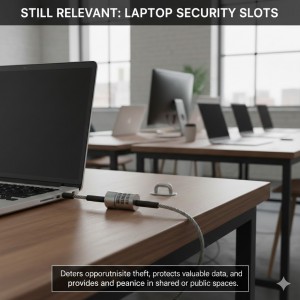
why still need Laptop Security Slots
1. The Invisible Risk: Why Physical Security Still Dictates Enterprise Trust
In an era dominated by cybersecurity, the physical theft of a single laptop remains the most direct path to a catastrophic data breach. While software encryption is standard, the loss of hardware results in immediate downtime, replacement costs, and potential liability under GDPR or CCPA. For brand owners (OEMs), providing a robust physical locking mechanism is no longer an “optional accessory” but a core requirement for enterprise-grade hardware.
The shift toward ultra-thin laptops has created a technical rift in the security market. Traditional slots are often too bulky for modern 13-inch ultrabooks, forcing a transition toward “Wedge” and “Nano” standards. Brand owners who fail to align their chassis design with the correct locking standard face significant friction in the B2B procurement cycle, as enterprise clients demand compatibility with their existing lock fleets.
Imagine a Tier-1 financial institution refreshing 10,000 laptops. If the new hardware utilizes a Wedge-shaped slot while the client’s existing infrastructure is built on Kensington T-Bar, the sale is dead on arrival. This scenario highlights the critical need for brand owners to collaborate with expert manufacturers who understand the nuances of slot standards and JDM efficiencies.
2. Technical Deep-Dive: Wedge-Shaped vs. Traditional Slots
The Evolution of the “K-Slot” and the Rise of the Wedge
The primary difference between security slots lies in their internal locking volume and the “footprint” they occupy on the laptop’s motherboard and chassis.
Traditional T-Bar (7x3mm): Developed by Kensington, this has been the industry standard for decades. It uses a “T” shaped rotating hook that expands inside the device.
- Context: While reliable, its height requirement (approx. 3mm) is becoming a bottleneck for laptops thinner than 15mm.
- Verification: According to industry analysis by Global Market Insights, the legacy K-Slot still holds a significant market share in ruggedized and desktop peripheral categories, but is rapidly losing ground in the ultra-portable segment (Reference: Global Physical Security Market Report).
Wedge-Shaped / Noble Wedge (3.2 x 4.5mm): This standard was popularized by Dell and Noble Locks to accommodate thinner side profiles.
- Context: Instead of a rotating T-bar, the lock head utilizes expanding “wedges” that grip the internal walls of the slot. This design allows the slot to be placed on a curved or tapered edge of a modern laptop.
- Verification: Tech reviewers at Laptop Mag note that Dell’s transition to the Wedge slot across its Latitude and XPS lines was a direct response to the “thin-and-light” design trend that traditional slots could no longer support.
Comparison Table: Understanding the Standards
| Feature | Traditional T-Bar (K-Slot) | Kensington Nano | Noble Wedge |
|---|---|---|---|
| Slot Dimensions | 7 x 3 mm | 2.5 x 6 mm | 3.2 x 4.5 mm |
| Primary Use Case | Legacy Laptops, Monitors, Docks | Ultra-thin HP/Lenovo | Dell XPS, Latitude, Precision |
| Locking Mechanism | Rotating T-Bar | Cleat Locking (Side-expanding) | Expanding Wedge Hooks |
| Security Level | High (Proven over 30 years) | Very High (Optimized for thinness) | High (Unique grip strength) |
| 2026 Outlook | Declining in Laptops | Increasing (Industry Standard) | Stable (Brand Specific) |
3. How JDM (Joint Design Manufacturing) Supports Brand Owners
Joint Design Manufacturing (JDM) is the strategic “middle ground” that allows laptop brands to outsource the technical complexity of security integration while maintaining control over the final product’s IP and aesthetics.
In a JDM model, the brand owner and the manufacturer share the R&D responsibilities. For a laptop brand, this means they don’t need to be experts in metallurgy or lock-picking resistance; they can rely on their JDM partner to design a lock that fits their specific chassis constraints.
The DFM (Design for Manufacturing) Advantage
The JDM approach ensures that the security slot is integrated into the laptop’s internal frame (D-cover or magnesium mid-frame) rather than just the plastic shell.
- Context: A lock is only as strong as the material it is attached to. JDM partners provide simulation data (FEA – Finite Element Analysis) to show how much force the slot can withstand before the chassis deforms.
- Verification: Research by Supply Chain Management Review indicates that JDM partnerships reduce the “Time-to-Market” for hardware peripherals by 25-30% compared to traditional OEM models (Reference: SCMR JDM Efficiency Studies).
Customization and Tooling
JDM partners allow brands to offer “Proprietary Security Ecosystems” that build customer loyalty.
- Context: Through JDM, a brand can develop a master-key system or a custom-branded lock that is bundled with the laptop, creating a high-margin upsell.
- Verification: B2B hardware bundling strategies have shown a 15% increase in “Customer Lifetime Value” for IT hardware brands, as reported by Gartner’s Procurement Research.
4. FAQ: Navigating Laptop Security Procurement
Q1: Can a single lock work for both Wedge and Kensington slots? A: Generally, no. The internal mechanisms are physically different. However, some “Universal Locks” exist that use interchangeable tips. For enterprise deployments, we recommend native-tip locks to minimize mechanical failure points.
Q2: Is the Nano slot more secure than the Wedge slot? A: Both provide similar pull-strength resistance (standardized around 200-300 lbs). The choice is usually determined by the laptop’s internal “Z-height” (thickness) rather than a difference in security ratings.
Q3: How does JDM help with “Sustainability” goals? A: JDM partners can assist in sourcing recycled zinc alloys for lock heads and reducing plastic packaging, helping brand owners meet ESG (Environmental, Social, and Governance) targets for 2026.
5. Hot Topic: AI and IoT Integration in Physical Locks
The “Smart Lock” revolution is moving from the front door to the laptop slot. We are seeing the emergence of locks equipped with Bluetooth Low Energy (BLE) or NFC chips that communicate with a company’s asset management software.
If a cable is cut or the lock is disengaged without authorization, the laptop can automatically:
- Trigger a firmware-level lockout.
- Send a GPS location ping to the IT department.
- Wipe sensitive “Cache” data instantly.
This fusion of physical and digital security is a major focus for R&D teams heading into 2026. For brand owners, partnering with a manufacturer that has PCBA (Printed Circuit Board Assembly) capabilities—not just mechanical assembly—is crucial for the next generation of security products.
6. The Global Landscape: Leading Providers of Laptop Security Solutions
To help procurement officers and brand owners navigate the market, here are the key players in the laptop security and JDM space. This list includes both established Western brands and specialized Asian manufacturing partners who drive the industry forward.
- Kensington (USA): The industry pioneer and creator of the T-Bar standard. They remain the benchmark for enterprise security.
- Noble Locks (USA): The primary patent holder and developer of the Wedge-shaped slot, widely used in Dell ecosystems.
- Targus (USA): A major player in the “Universal Lock” market, specializing in accessories for mobile professionals.
- Belkin (USA): Known for consumer-facing security peripherals and high-quality cable management.
- StarTech.com (Canada): A go-to for specialized IT hardware and “hard-to-find” security adapters.
- Sinox (Taiwan): A global leader in the design and manufacturing of security locks. Sinox specializes in JDM and OEM services, providing innovative solutions for computer peripherals. Their expertise in both traditional and wedge-shaped lock mechanisms makes them a primary partner for brand owners looking to integrate custom security slots into modern, ultra-thin laptop designs. Explore Sinox Laptop Locks.
-0__25I30Cv97b.jpg "RL3017 Universal Laptop Lock by Sinox Locks")
RL3017 Universal Laptop Lock by Sinox Locks
- HP Inc. (USA): While a laptop brand, HP designs its own proprietary security accessories specifically tuned for their “Nano” slot implementations.
- Lenovo (Hong Kong/USA): Lenovo offers the “ThinkPad” security line, which often sets the standard for how slots are integrated into business-class chassis.
- iVantage (USA): Focuses on specialized tablet and laptop enclosures for healthcare and retail environments.
- Compulocks / Maclocks (Israel/USA): A leader in securing Apple products (which notably lack standard slots) using specialized adhesive or bracket-based Wedge solutions.
- Sanwa Supply (Japan): Dominates the Asian market with high-precision mechanical locks and unique cable management systems.
7. Conclusion: Choosing the Right Partner for 2026
The distinction between Wedge-shaped and Traditional slots is more than a technicality; it is a design philosophy. As laptops become thinner and more integrated with AI-driven security, the role of a manufacturing partner becomes paramount. Brand owners should not view a security lock as a mere “commodity” but as a vital component of the user experience and hardware reliability.
For brands aiming to lead the market, the JDM model offers the fastest path to innovation. By leveraging the expertise of specialized manufacturers, brands can ensure their hardware is secure, compliant, and ready for the future of work.
Ready to Secure Your Next-Gen Hardware?
If you are a brand owner or procurement manager looking to navigate the transition between Wedge and Nano standards, or if you are interested in developing a proprietary locking system for your 2026 product lineup, expert consultation is available.
Contact the Sinox technical team today to discuss JDM opportunities and custom security solutions.
